
Mold Remediation in Bowie, MD — The Bowie Mold Map
The places we find (and fix) hidden mold growth in Bowie homes — mapped to the way these Levitt-era and newer estate homes are actually built. Then the process that removes it, and the reason it usually comes back when it is done wrong.
The Bowie Mold Map
Where hidden mold lives in Bowie homes
Bowie's housing stock is unusual — a planned community built in waves. The mold we find follows the construction. These six locations account for most of what our crews remove in the city.
Split-foyer & raised-ranch lower levels
Pointer Ridge, Belair-at-Bowie, Meadowbrook and South Bowie are full of split-foyers where the lower level sits partly below grade. Block walls wick ground moisture, and drywall furred onto those walls traps it against the masonry where growth starts behind the finish.
Drywall furring against masonry
The original Levitt-era construction often furred drywall directly against basement block with little insulation and no drainage plane. Any wall leak or rising damp reaches the drywall paper — the food mold grows on — long before it shows on the paint.
Crawl spaces under the newer estates
Newer homes around Fairwood and Woodmore often have vented crawl spaces that still see condensation and groundwater. Bare soil brings humid air into the space, and the floor system above sits directly over it.
Rim joists & sill plates
The band of framing at the top of the foundation line is where outside air meets the warm interior — exactly where condensation forming on cold surfaces feeds growth. It is hidden behind soffit ventilation and insulation.
1970s bathrooms & laundry rooms
Bathrooms that predate proper exhaust often vent into a soffit, attic or wall cavity. Moisture settles in the ceiling above, the wall behind tile, or the closet next door — none of which you see from inside the bathroom.
Past-life supply lines & water heaters
Supply lines and water heaters at or past their service life fail slowly, not all at once. A slow supply-line or water heater leak in an insulated wall or below a cabinet feeds growth inside the cavity for months.
How We Fix It
Bowie mold remediation, start to finish
Certified, insured, and based in Bowie — so the crew that inspects is the crew that remediates, and there is no mystery about who shows up.
Free moisture inspection
Thermal imaging and pin meters map the wet areas in the lower level, crawl space and wall cavities. You get photos and a written scope — the same evidence an adjuster will want.
Containment & negative air
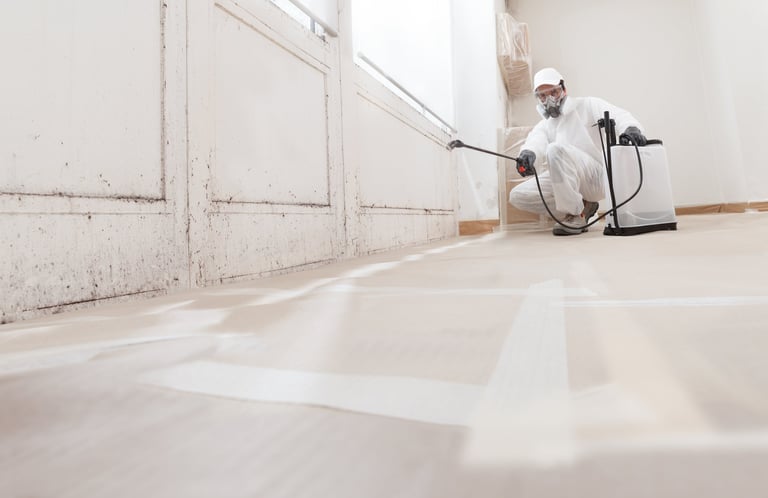
Poly barriers and HEPA negative air keep spores out of the rest of the house while growth is removed from the contained area.
Removal & HEPA cleaning
Contaminated drywall, insulation and debris come out; framing and block get HEPA vacuuming and antimicrobial treatment.
Dry & verify
Drying to a verified dry standard with daily moisture readings — not a guess from a hand on the wall.
Source fix & rebuild
The moisture source is fixed or documented, then the space is rebuilt — drywall, trim and paint — typically 3–5 days total for a contained lower level.
Want the full method explained? Read the professional mold remediation process guide.
Bowie mold remediation questions
How fast can you reach a Bowie home for mold remediation?+
Pure Resto is based in Bowie, MD 20715. Our crews typically reach a Bowie home within about 30 minutes of your call, 24/7 — including holidays.
Why does mold come back in my Bowie basement?+
Almost always because the block wall behind the drywall was never dried or sealed, or the source was never fixed. The surface looks clean, but the moisture in the cavity feeds a new bloom within weeks. We meter the wall base and furring cavity before deciding what has to come out.
Does my insurance cover mold remediation in Bowie?+
Often, when it follows a covered event like a burst supply line or flooded basement. Maintenance-related damp is usually excluded. We document with photos, readings and a scope formatted for adjusters, and bill your insurer directly.
What does remediation cost in Bowie?+
A contained single area is typically in the low thousands; a full lower-level removal and rebuild costs more. We give a written estimate after the free inspection, before any work begins — no surprises.
For what a remediation involves from day one, see the Bowie mold inspection page or the step-by-step remediation process.
See mold in your Bowie home?
Free inspection with thermal imaging and a written scope — no obligation. We are based right here in Bowie, MD 20715.