Start here
The Hidden-Mold Checklist: 7 signs the problem is bigger than what you can see
Most mold problems people call us about start with something they noticed — a smell, a stain, an allergy that got worse. Tick any of these and it is worth a professional moisture inspection before you start cleaning.
- 1A musty, damp smell in one room or after it rains — even with nothing visible.
- 2Discolored rings, bubbling paint or soft spots on walls, ceilings or under sinks.
- 3Symptoms that ease when you leave the house: congestion, headaches, irritation.
- 4A water event in the last 12 months — burst pipe, roof leak, basement flooding.
- 5Mold reappearing on the same surface after you clean it.
- 6A humid basement, crawl space or bathroom with no exhaust fan vented outside.
- 7Mold near HVAC returns or visible on registers and grilles.
Any of these? A moisture inspection with thermal imaging takes under an hour and tells you exactly what you are dealing with. See how our mold inspection works.
The Process
What professional remediation actually involves
Six steps, in order. Every one matters — this is the difference between a job that lasts and a cosmetic fix that comes back next season.
1. Assessment & Scope
A certified tech maps the moisture: thermal imaging and pin-type meters find wet pockets behind drywall, under flooring and in framing. Air and surface samples may be taken to confirm what is growing. The result is a written scope — what comes out, what stays, and what the job will cost before anyone lifts a tool.
You get a written estimate and an insurance-ready scope.
2. Containment & Negative Air
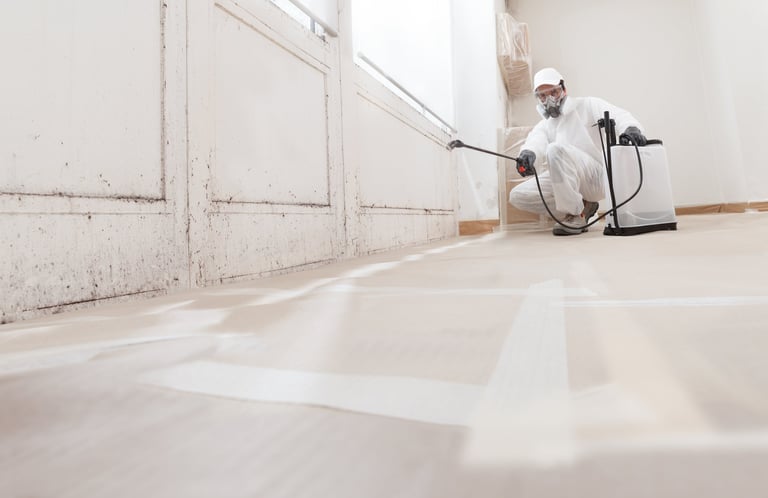
Poly barriers seal the work area, and HEPA-filtered negative air machines pull air out of the contained zone so spores travel into a filter rather than into the rest of your house. For larger jobs a decontamination chamber is built at the entrance so people and equipment don't re-seed the clean rooms.
This is the step most cheap jobs skip — and why mold comes back.
3. Physical Removal
Porous materials with growth on them — drywall, insulation, carpet padding, some ceiling tiles — are bagged and removed, not painted over. Semi-porous surfaces like wood studs and concrete get HEPA vacuuming and wire-brushing. This is the only way to actually remove mold; sprays and foggers alone do not.
Mold cannot be 'killed clean' in place — contaminated material comes out.
4. Antimicrobial & HEPA Cleaning
Remaining structural surfaces are HEPA-vacuumed, then treated with an antimicrobial product registered for the surface. Ducted HVAC components are cleaned separately if spores reached them — otherwise the system blows contamination back through every room.
HVAC inspection is part of the job, not an add-on surprise.
5. Clearance Verification
Before equipment comes down, the area is dry, visibly clean and — on larger or health-sensitive jobs — air-tested by an independent party. Clearance is the objective proof the job worked. Without it, 'done' is one contractor's opinion.
Ask for clearance results in writing, especially after an insurance claim.
6. Source Control
Mold returns to any surface that stays damp. The roof leak gets fixed, the crawl space gets a vapor barrier and dehumidifier, the bathroom fan gets vented outside. Remediation without source control is a cleaning, not a repair — the growth comes back in weeks.
We fix or document the water source before we finish.
DIY vs. Professional
What you can clean yourself — and what you shouldn't
The EPA's rule of thumb is about 10 square feet (roughly 3×3 ft). Below that, on a hard surface, detergent and water is fine. Above it, in porous materials, or after a water loss, handling it yourself sends spores through the house and risks your health.
Not sure which side of the line you are on? A certified mold inspection gives you a straight answer before you spend anything on cleanup.
Common questions about mold remediation
How long does professional mold remediation take?+
A single room typically takes 1–3 days including drying and clearance. Whole-floor or attic jobs run 3–7 days. If building materials need to be removed and replaced, reconstruction adds time on top of remediation itself.
Will my insurance cover mold remediation?+
Often, when the mold is the result of a covered event — a burst pipe, appliance leak, or storm-driven water intrusion. Maintenance-related mold (long-term humidity, an old slow leak) is usually excluded. We document everything with photos, moisture readings and a scope in the format adjusters expect.
Can I stay in the house during remediation?+
For a contained single room, usually yes. For larger jobs with negative air equipment running, or if your home has a central return near the work area, many families prefer to stay elsewhere for a day or two. We'll tell you what the specific job calls for before we start.
Does remediation include replacing the drywall?+
Remediation removes contaminated drywall and cleans what stays. Putting the wall back — insulation, drywall, paint, trim — is reconstruction. We handle both, and the written estimate shows each separately so you can compare quotes fairly.
Is bleach a safe way to remove mold?+
No for porous surfaces — bleach is water-based and cannot reach into drywall paper or wood, and it leaves its own moisture behind. EPA guidance directs homeowners to detergent and water for small hard-surface spots; anything larger belongs in a professional containment with HEPA equipment.
What is a 'clearance test' and do I need one?+
Air or surface samples taken after remediation to confirm spore counts are back to normal levels. It is independent verification the job worked. It is strongly recommended after any insurance claim and anytime the job was bigger than one small contained area.
Ready for a straight answer on your mold?
Free inspection, written scope, and insurance documentation — from an IICRC-certified Maryland crew. Available 24/7.